
Logan County Court Records After a Jail Arrest
After a Logan County jail arrest, the public record splits into three tracks: jail custody, the prosecutor's charging decision, and the court docket. The booking record reflects what the arresting officers wrote down. The court record reflects what the Logan County State's Attorney actually filed, which can differ from the arrest charge. Once a person is booked, the prosecutor may file, amend, reduce, or decline charges, and those filings become the official court record for the case. So court records after an arrest are the charges, hearings, and dispositions that the circuit clerk maintains.
The two sides connect but are not the same. For the custody and booking side, the Logan County jail inmate records page covers the roster and how a booking works, and booking photos are handled on the jail mugshots page. This page stays on the court side: the charges the prosecutor filed after the arrest, how to find them, and what each charge status means.
How to Find Logan County Court Records After an Arrest
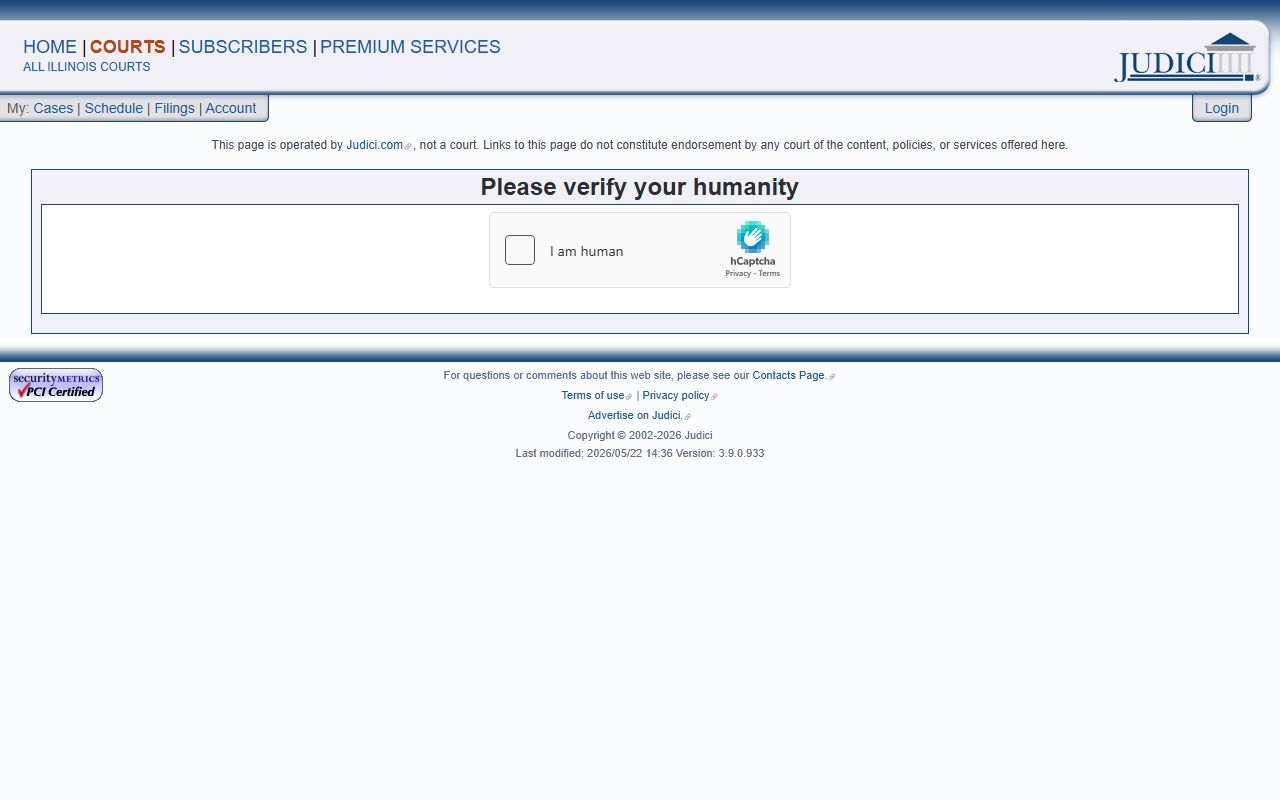
The jail page directs court questions, including next court appearances, to the Logan County Circuit Clerk and the Judici case search. Judici is a private portal that participating Illinois courts use, and the Logan County result page notes it is run by Judici, not the court itself. Access can stop at a human-verification step, so the circuit clerk is the official record custodian behind it.
- Open the Judici Logan County case search.
- Search by defendant name or by a case number from a sheriff release.
- Open the case and read the charge list and the filed counts.
- Check each charge's level and current status, and note the next hearing date.
The Judici case-search entry point is shown below, including the verification step a user may meet.
The Logan County case index is reached through the Judici Logan County portal.
If the portal blocks access or the case is older, the circuit clerk's mail and fax search is the reliable fallback, described next.
How Charges Get Filed After an Arrest
Working forward from the arrest, booking happens at the jail, and the court record begins when the prosecutor files a charging document. Illinois uses three main types, and the type often signals how serious the case is. A complaint commonly starts a misdemeanor, an information starts many felonies, and an indictment from a grand jury starts the most serious felonies. Each one opens the court case that the records search will show.
| Complaint | Information | Indictment | |
|---|---|---|---|
| Filed By | Officer or Prosecutor | Prosecutor | Grand Jury |
| Common For | Misdemeanors | Many felonies | Serious felonies |
| Starts | The case | The case | The case |
The Logan County State's Attorney, Bradley Hauge, represents the People in these prosecutions under the authority the Illinois Constitution and 55 ILCS 5/3-9005 give the office. Because the prosecutor controls the charge, the arrest charge on a booking or a news release is not the final word, and the court record is where the filed charge appears.
The State's Attorney After a Logan County Arrest
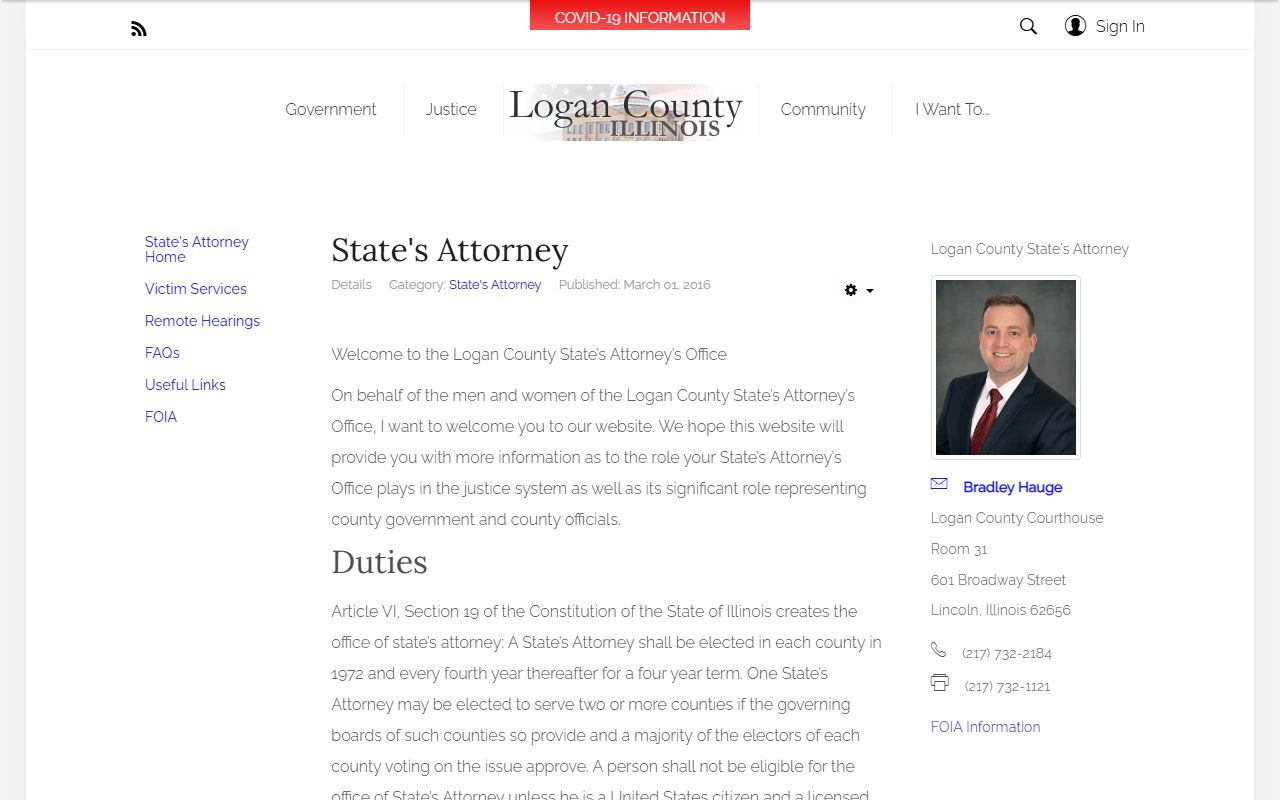
The Logan County State's Attorney is the office that turns arrest facts into a prosecution decision, and it shapes what the court record after an arrest looks like. Bradley Hauge holds the office at Room 31 of the Logan County Courthouse, 601 Broadway Street, with a phone line at 217-732-2184. The office represents the People in criminal cases and also advises county government. After an arrest, the prosecutor can file the charges, amend or reduce them, add counts, or decline to proceed, which is why the booking charge and the filed charge often differ.
The office also runs victim services, including a victim and witness coordinator, restitution help, and Crime Victims Compensation guidance, and victims can register for custody and case notifications through Illinois VINE. The State's Attorney contact and role page is shown below.
The prosecutor's contact details appear on the Logan County State's Attorney page.
Because the prosecutor controls the charge, the court docket maintained by the circuit clerk is the place to confirm what was actually filed, amended, or dismissed after an arrest.
Circuit Clerk Record Searches in Logan County
The Logan County Circuit Clerk keeps the official court record and offers a mail or fax criminal-record search when the online portal does not work. The clerk asks for the full name, the middle initial, and the date of birth. The cost is 5 dollars per year searched, and payment must arrive with the request or before the search runs. Pre-1990 records are researched by mail, while post-1990 records are online. Public access terminals in the clerk's office let anyone look up non-impounded cases at no charge.
The clerk's record-search instructions and fee are shown below.
The procedure is published on the Logan County Circuit Clerk record-search page.
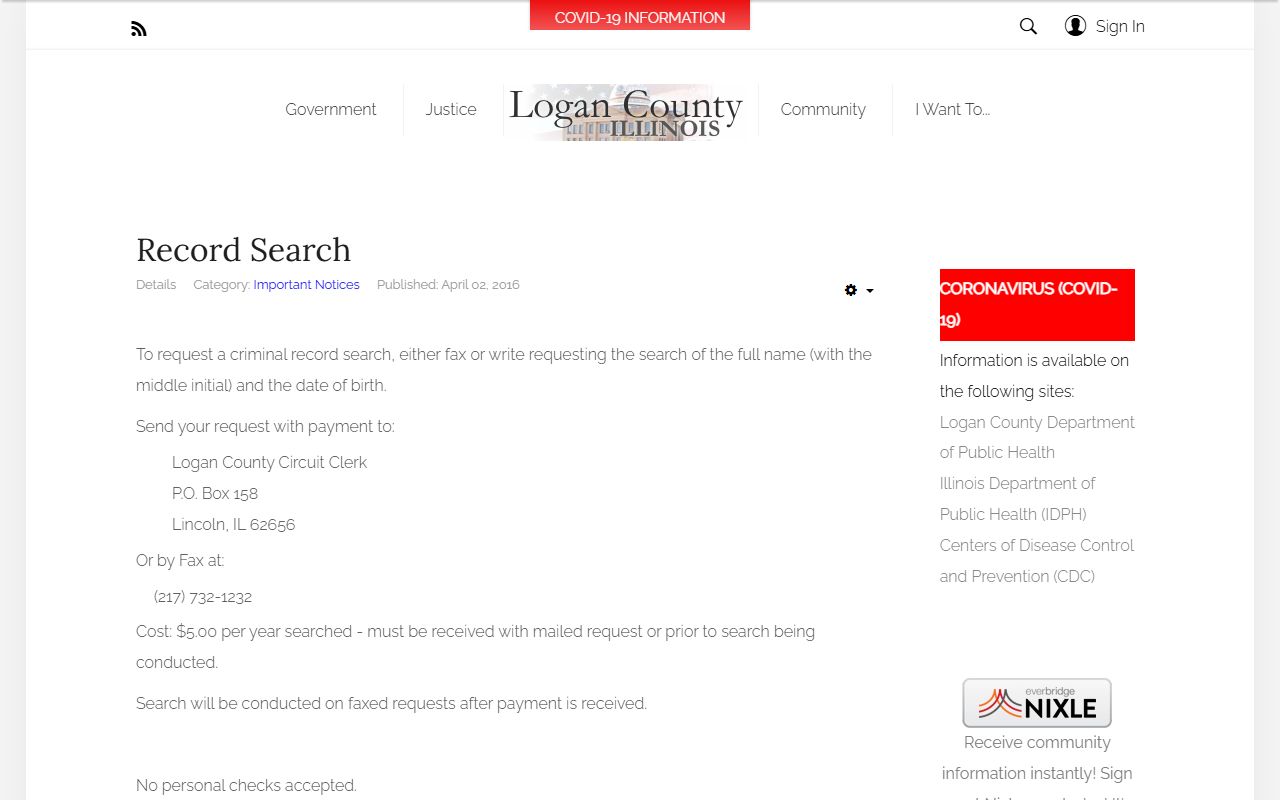
Mail requests go to the Logan County Circuit Clerk, P.O. Box 158, Lincoln, IL 62656, and fax requests go to 217-732-1232, a useful route for anyone who cannot pass the online verification step.
Charge Status in Logan County Court Records
Charges change as a case moves through court. A count can be amended, reduced, added, or dropped, and the booking charge on the jail side can differ from the charge the prosecutor finally files. The court record tracks each of these steps, so reading the status correctly matters. The terms below appear most often in a Logan County case.
| Status | What It Means |
|---|---|
| Pending | The case or charge is still open and moving through court. |
| Amended / Reduced | The prosecutor changed a charge or lowered it to a lesser offense. |
| Dismissed | The charge was removed by the court or the prosecutor. |
| Nolle Prosequi | The prosecutor formally declined to proceed on a charge. |
Note: a disposition is the final outcome of a charge, while a conviction is a finding or plea, so a dismissed or nolle charge is not a conviction.
Bond and Release After a Logan County Arrest
Illinois is no longer a cash-bail state, which changes what release looks like after an arrest. Article 110 of the Code of Criminal Procedure governs pretrial release and detention. Monetary bail is abolished, release is presumed, and the State must meet a statutory standard at a hearing to keep someone in custody. People still use the word bond locally, and the jail page even mentions adding funds for bond, but that wording sits next to a court process that no longer turns on a posted cash amount. For a current release question, the jail phone line, the court record, or an attorney is the right path.
| Term | How It Works |
|---|---|
| Pretrial release | Release while the case is pending, under Article 110 conditions. |
| Detention | Continued custody after a hearing when the statutory standard is met. |
| Monetary bail | Abolished in Illinois; the case does not turn on a posted cash amount. |
| Hold / detainer | A separate warrant or out-of-county hold can block release. |
Warrants That Lead to a Logan County Arrest
Many Logan County bookings begin with a warrant. There is no single public warrant database for the county, so warrant information surfaces through sheriff news releases, the court record, and a records request. Releases regularly describe failure-to-appear arrests and out-of-county warrants from places like Tazewell, Macon, Sangamon, or Douglas counties. When a release lists a case-style number, that number can be searched in the court records. If the warrant came from another county, that county's court is where the final status lives, even though the arrest happened in Logan County. To clear a warrant, contact an attorney or the issuing court rather than appearing at a counter without guidance.
Arrest-to-Court Routing in Logan County
Where a court record lives depends on how the arrest happened, and a few common patterns repeat in Logan County. Matching the arrest to the right court saves a long search through the wrong index.
- A local warrant arrest with a Logan County case number can be searched in Judici, or asked for through the circuit clerk if the portal blocks access.
- An out-of-county warrant arrest means Logan County was the arrest location, but the issuing county's court holds the case status.
- A fresh arrest without a case number may not show in court records yet, so use the arrest date, name, and agency to call the jail or check back later.
- A case that ends in a prison sentence appears in the state corrections record, which shows the sentencing county and offense but not the full court file.
For most local cases, the Logan County Courthouse at 601 Broadway Street is the hub, with the circuit clerk keeping the docket and public access terminals available in the office at no charge.
Charges vs. Convictions in Court Records
An arrest and a charge are accusations, not proof of guilt. A conviction only happens after a plea or a verdict. Both a charge and a conviction can appear in the public court record, but they carry very different weight, and reading one as the other is a common error after an arrest.
| Charge | Conviction | |
|---|---|---|
| Stage | Accusation | Verdict or plea |
| Burden of Proof | Probable cause | Beyond a reasonable doubt |
| Public Record | Yes | Yes |
Sealed vs. Expunged Arrest Records
Illinois lets people clear some records after a dismissal or an eligible outcome. Sealing and expungement are governed by 20 ILCS 2630/5.2, and they do different things. Sealing hides a record from most public view while leaving limited law-enforcement access. Expungement removes the record so it is treated as if it never existed. Eligibility depends on the charge and the outcome, and the request goes through the court, not a private service.
| Sealed | Expunged | |
|---|---|---|
| Visibility | Hidden from most public view | Destroyed or treated as never existed |
| Law Enforcement | Limited access remains | Very limited access |
| Governed By | 20 ILCS 2630/5.2 | 20 ILCS 2630/5.2 |
Important: Logan County Inmate Population is not an FCRA-regulated consumer reporting agency, and nothing here may be used for employment, housing, credit, or insurance screening.
Restricted Court Records After an Arrest
Not every court record after an arrest is open. Illinois court access runs under 705 ILCS 86/5 and Illinois Supreme Court Rule 8, which presume access but treat public remote access differently from courthouse or clerk access. Juvenile arrests, sealed and expunged cases, impounded files, and records tied to an ongoing investigation can all be withheld. Public remote search may show less than the clerk's counter does, which is why the mail or in-person clerk search remains the deeper route for an older or restricted case.